Problems, Causes, Solutions to environmental impacts caused by dairy farming:
Problem
- Contamination of ground water by nutrients from cow wastes and nitrogen fertilisers
Cause
- Leaching of nutrients (over supply of nutrients seeping) into soil in paddocks
- Increased stock densities eg Taranaki: 1975 – 1.43 cows/ha compared to 1996 – 1.70 cows/ha
Solution
- Reduce fertiliser application
- Reduce stock densities
- - - - - - - - - - - - - - - - - - - - - - - - - - - - -
Problem
- Contamination of streams, rivers and lakes by nutrients from cow wastes and nitrogen fertilisers
Cause
- Surface run-off from paddocks
- Effluent from cowsheds washed into farm streams from cowsheds
- Increased stock densities
Solution
- Reduce fertiliser applications
- Fence off riparian zones (stream banks) and plant shrubs and trees to trap surface run-off
- Better collection, treatment and disposal of cowshed wastes, eg. Two-pond system (Oxidation Ponds)
- Reduce stock densities
- - - - - - - - - - - - - - - - - - - - - - - - - - - - -
Problem
- Pugging
Cause
- Trampling of grass by cows
- Increased stock densities
Solution
- Create races for the cows to walk on around the farm
- Reduce stock densities
Saturday, September 29, 2007

FQ 4. Describe the system of dairy farming
A system includes inputs, processes, outputs and feedbacks.
This is a generic system diagram for dairy farming. You need to use specific information from your farm to get Merit and Excellence.
Inputs
- sunshine
- fertile volcanic soils
- rolling relief
- tractors
- cows
- grass
- fertiliser
- herringbone milking shed
Processes
Outputs
- waste
- unused effluent, plastics, spray cans
- silage
- hay
- calves
- profit
Feedbacks
This is a generic system diagram for dairy farming. You need to use specific information from your farm to get Merit and Excellence.
Inputs
- Natural
- sunshine
- fertile volcanic soils
- rolling relief
- Cultural
- tractors
- cows
- grass
- fertiliser
- herringbone milking shed
Processes
- These are all the activities that occur in the annual farming cycle
Outputs
- Negative
- waste
- unused effluent, plastics, spray cans
- Positive
- silage
- hay
- calves
- profit
Feedbacks
- Profits reinvested
- Effluent used as fertiliser
- Heifers used as replacement cows
- Silage and hay used as suppliement feed
3.2 Annual Cycle of Dairy Farming Activities
Activities on a farm are dependant on the season. Different seasons produce different climatic conditions that are condusive (good) for different activities.
Farming activities vary depending on where a farm is located in New Zealand. Remember it is warmer is the North Island than the South Island so farmers would tend to do things later in the South Island compared to the North Island.
Here is a link to a farm in the South Island and the activities they do in each season: Codstream Downs Dairy Farm
The activites down on the Coldstream farm are slightly different to Mr Wootton's farm. Here is the annual cycle on Mr Wooton's dairy farm.
Winter:
Farming activities vary depending on where a farm is located in New Zealand. Remember it is warmer is the North Island than the South Island so farmers would tend to do things later in the South Island compared to the North Island.
Here is a link to a farm in the South Island and the activities they do in each season: Codstream Downs Dairy Farm
The activites down on the Coldstream farm are slightly different to Mr Wootton's farm. Here is the annual cycle on Mr Wooton's dairy farm.
Winter:
- Feeding out/supplementing feed - this is when Mr Wootton feeds hay and silage to the cows because there is very little grass growth for the cows to eat fresh grass.
- Towards the end of winter, Mr Wooton is into calving. The calves are kept in a calf shed until they are weaned off milk and able to eat grass. He wants the calves ready to be able to eat the spring grass. Once calving begins, Mr Wooton can begin milking.
- Once the cows have calved, artifical insemination begins.
Spring:
- Weaning contines
- Milking continues
- Silage is made. This is because there is an oversupply of grass
- Mating (in case the AI has not worked)
- Pregnancy testing
Summer:
- Milking continues
- Hay is made.
- Suppliment is sometimes fed in drought conditions
Autumn:
- Milking reduces to once a day
- Cows are eventually dried off to give them a break
- Maintenance is carried out on the farm
- Cows are drenched
And then winter starts all over again.
These are some of the activities that occur on the annual dairy farming cycle. These are also most of the processes that occur on a dairy farm.
Saturday, August 18, 2007
FQ 3. Describe the annual cycle of a dairy farm (winter, autumn, summer, spring).
3.1 Four Seasons in New Zealand
FQ 2. Describe the distribution pattern of farming in New Zealand.
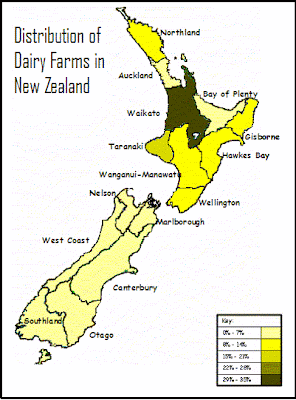
2.1 Where is dairy farming located in NZ?
Different farm types have different resource requirements. Dairy farming needs specific natural resources like
- flat land
- fertile soil
- plenty of sunshine and rain
- close to population centres
Look closely at this map to see dairy farming is mostly located. Look at a relief and climate map of New Zealand to see exactly why dairy farming is located in these areas.
2.2 New Zealand’s farming resources
Cultural Resources
PEOPLE:
The people on the farms are resources. They provide labour, knowledge, skills, and perception. All of these affect the type of farming that happens; how the farm is managed, where the farm is bought, and how efficiently the farm is run. An example of farming knowledge is agricultural research (which happens at Ruakura in Hamilton). Farming skills include fencing, shearing and pasturing.
SERVICES:
Another kind of resource is services (these are services to the farmer). These include financial (eg. Rural banks and banking), government (eg. Ministry of Agriculture and Fisheries (MAF) officers and advisors), professional (eg universities), and agricultural (eg. Marketing boards). These provide advice and direction, money, efficiency, informal management and marketing.
FACILITIES:
Facilities include buildings (sheds), technology, machinery and transport for storage and general equipment. New technologies can enable farmers to do certain tasks much faster, allowing them to spend time doing other things.
Natural Resources
LAND:
The kind of land available, affects the kind of farming that happens on the land. For example, a lot of horticulture and dairy farming is found on lowland plains, while gentle rolling hills are used for sheep and beef farming. Most of New Zealand is a mixture of hills and mountains, with plains and plateaus sparsely placed in between. Most farming is carried out on the plains (close to sea level) or on low land plateaus.
SOIL:
Farming needs certain kinds of soils. A deep soil, rich in minerals is best for farming. Soils in New Zealand range from alluvial (to do with rivers) to volcanic and are the result of different natural processes. Many lowland areas have alluvial soils that are good for horticulture. Most of New Zealand is hilly with thin soils which are suitable mainly for tree or grass growth.
SUN:
The sun is responsible for temperature and sunshine hours. New Zealand’s location (between 35˚S and 47˚S) means that overall the country has mild temperatures and high sunshine hours. New Zealand’s temperature (which affects how long and how much you can grow) is excellent for growing in spring and summer and average in winter and autumn. Some temperatures in the north allow you to grow crops all year long. Sunshine hours are important for the ripening of fruit and vegetables (photosynthesis) and growing of grass. Most of New Zealand gets between 1800 and 2200 hours of sunshine per year.
RAIN:
Precipitation (rain, hail, sleet and snow). Plants and animals need water to survive. Much of New Zealand receives at least 1000mm per annum (per year). Fiordland is very wet (well over 3000mm); while Otago can be quite dry (can receive less than 500mm). Water keeps moving between the sky and the earth in the hydrological cycle.
Different farm types have different resource requirements. Dairy farming needs specific natural resources like
- flat land
- fertile soil
- plenty of sunshine and rain
- close to population centres
Look closely at this map to see dairy farming is mostly located. Look at a relief and climate map of New Zealand to see exactly why dairy farming is located in these areas.
2.2 New Zealand’s farming resources
Cultural Resources
PEOPLE:
The people on the farms are resources. They provide labour, knowledge, skills, and perception. All of these affect the type of farming that happens; how the farm is managed, where the farm is bought, and how efficiently the farm is run. An example of farming knowledge is agricultural research (which happens at Ruakura in Hamilton). Farming skills include fencing, shearing and pasturing.
SERVICES:
Another kind of resource is services (these are services to the farmer). These include financial (eg. Rural banks and banking), government (eg. Ministry of Agriculture and Fisheries (MAF) officers and advisors), professional (eg universities), and agricultural (eg. Marketing boards). These provide advice and direction, money, efficiency, informal management and marketing.
FACILITIES:
Facilities include buildings (sheds), technology, machinery and transport for storage and general equipment. New technologies can enable farmers to do certain tasks much faster, allowing them to spend time doing other things.
Natural Resources
LAND:
The kind of land available, affects the kind of farming that happens on the land. For example, a lot of horticulture and dairy farming is found on lowland plains, while gentle rolling hills are used for sheep and beef farming. Most of New Zealand is a mixture of hills and mountains, with plains and plateaus sparsely placed in between. Most farming is carried out on the plains (close to sea level) or on low land plateaus.
SOIL:
Farming needs certain kinds of soils. A deep soil, rich in minerals is best for farming. Soils in New Zealand range from alluvial (to do with rivers) to volcanic and are the result of different natural processes. Many lowland areas have alluvial soils that are good for horticulture. Most of New Zealand is hilly with thin soils which are suitable mainly for tree or grass growth.
SUN:
The sun is responsible for temperature and sunshine hours. New Zealand’s location (between 35˚S and 47˚S) means that overall the country has mild temperatures and high sunshine hours. New Zealand’s temperature (which affects how long and how much you can grow) is excellent for growing in spring and summer and average in winter and autumn. Some temperatures in the north allow you to grow crops all year long. Sunshine hours are important for the ripening of fruit and vegetables (photosynthesis) and growing of grass. Most of New Zealand gets between 1800 and 2200 hours of sunshine per year.
RAIN:
Precipitation (rain, hail, sleet and snow). Plants and animals need water to survive. Much of New Zealand receives at least 1000mm per annum (per year). Fiordland is very wet (well over 3000mm); while Otago can be quite dry (can receive less than 500mm). Water keeps moving between the sky and the earth in the hydrological cycle.
FQ 1. Describe perceptions of resources: renewable, non-renewable, sustainable management.
1.1 Thoughts on resources
Accessibility is very important – remote locations make resources costly to develop.
Eg. The further away a farm is located from towns the more expensive it is to run. Vets will charge more, labourers will charge more…..
Some resources which were once valuable have now lost their importance.
Eg. A stool and a milk pale (bucket) are no longer resources that farmers value hugely.
Resources can go in and out of fashion.
Eg. Fertiliser was considered a “good thing” until people wanted to make sure that they were eating organic food.
Resources can have more than one use.
Eg.
Milk is made into a huge variety of milk types (low fat, calci trim); however milk is used to make cheese, sour cream, cream, butter…
Resources will only last as long as people choose to let them last.
Eg. If farmers over fertilise their land they run the risk of grass not growing as the soil becomes contaminated.
Use of resources can sometimes cause conflict.
Eg. People living near farms complain about tractors and cows mooing in the early hours of the morning. Noise restrictions could be imposed restricting the hours that farmers can work.
The use of some resources has created environmental problems.
Eg. Farmers have created pollution in local waterways as cow waste is allowed to enter the waterways without treatment.
The Resource Management Act (RMA), 1991 aims to make resource use sustainable.
Eg. Before farmers can build new facilities on their farms, they must gain resource consent and comply with all the laws so that the environment is not destroyed in any way.
1.2 Resources?
- A resource is something we use.
- A natural resource is a resource made by nature (not people).
- A cultural resource is a resource made by people (not nature).
Eg Natural Resources
- Indigenous Trees
- Rivers
- Sea
- Mountain
- Fish
- Sun
- Air
- Rain (precipitation)
- Grass
- Soil (eg volcanic soils)
eg. Cultural resources
- People
- Bread
- Genetically modified food
- Pens, books, pencils, chairs, tables
- Cars, tractor, quad bike, train, bus, bike
- Machines
- Milk shed
- Barn
- House
- Roads
- Concrete, metal
- Fences and gates
- Cows!!!!! Because the farmer breeds them.
Natural resources can be further classified as:
Renewable resources are resources which, after being used, can naturally replace or restore themselves. Eg water, air, soil, vegetation, sunshine.
Non-renewable resources are resources which, after being used, will not naturally replace or restore themselves, eg. Coal, gold. Once a gold deposit has been mined, it has gone forever.
Renewable resources may not naturally replace, or restore or replenish themselves if their use is not properly managed. Most renewable resources need sustainable management to guarantee their future availability. For example, the natural fertility of soil may not be sustained if the same crop is grown on it year after year. Other renewable resources, such as energy from the sun, are more easily sustained.
Accessibility is very important – remote locations make resources costly to develop.
Eg. The further away a farm is located from towns the more expensive it is to run. Vets will charge more, labourers will charge more…..
Some resources which were once valuable have now lost their importance.
Eg. A stool and a milk pale (bucket) are no longer resources that farmers value hugely.
Resources can go in and out of fashion.
Eg. Fertiliser was considered a “good thing” until people wanted to make sure that they were eating organic food.
Resources can have more than one use.
Eg.
Milk is made into a huge variety of milk types (low fat, calci trim); however milk is used to make cheese, sour cream, cream, butter…
Resources will only last as long as people choose to let them last.
Eg. If farmers over fertilise their land they run the risk of grass not growing as the soil becomes contaminated.
Use of resources can sometimes cause conflict.
Eg. People living near farms complain about tractors and cows mooing in the early hours of the morning. Noise restrictions could be imposed restricting the hours that farmers can work.
The use of some resources has created environmental problems.
Eg. Farmers have created pollution in local waterways as cow waste is allowed to enter the waterways without treatment.
The Resource Management Act (RMA), 1991 aims to make resource use sustainable.
Eg. Before farmers can build new facilities on their farms, they must gain resource consent and comply with all the laws so that the environment is not destroyed in any way.
1.2 Resources?
- A resource is something we use.
- A natural resource is a resource made by nature (not people).
- A cultural resource is a resource made by people (not nature).
Eg Natural Resources
- Indigenous Trees
- Rivers
- Sea
- Mountain
- Fish
- Sun
- Air
- Rain (precipitation)
- Grass
- Soil (eg volcanic soils)
eg. Cultural resources
- People
- Bread
- Genetically modified food
- Pens, books, pencils, chairs, tables
- Cars, tractor, quad bike, train, bus, bike
- Machines
- Milk shed
- Barn
- House
- Roads
- Concrete, metal
- Fences and gates
- Cows!!!!! Because the farmer breeds them.
Natural resources can be further classified as:
Renewable resources are resources which, after being used, can naturally replace or restore themselves. Eg water, air, soil, vegetation, sunshine.
Non-renewable resources are resources which, after being used, will not naturally replace or restore themselves, eg. Coal, gold. Once a gold deposit has been mined, it has gone forever.
Renewable resources may not naturally replace, or restore or replenish themselves if their use is not properly managed. Most renewable resources need sustainable management to guarantee their future availability. For example, the natural fertility of soil may not be sustained if the same crop is grown on it year after year. Other renewable resources, such as energy from the sun, are more easily sustained.
New Topic - Resource Use
For the next 2 and a half weeks, we are going to study renewable resource use in the context of dairy farming.
Case Study: Mr Wootton's Dairy Farm in Pukekawa
Acheivement Standard 90204 - 3 External Credits.
Focusing Questions
1. Describe perceptions of resources: renewable, non-renewable, sustainable management.
2. Describe the distribution pattern of farming in New Zealand.
3. Describe the annual cycle of a dairy farm (winter, autumn, summer, spring).
4. Describe the system of dairy farming (inputs, processes, outputs, feedbacks).
5. Describe how different people perceive the environmental impacts of dairy farming and the measures taken to resolve these impacts (natural and cultural, renewable and non-renewable, resource sustainability).
Case Study: Mr Wootton's Dairy Farm in Pukekawa
Acheivement Standard 90204 - 3 External Credits.
Focusing Questions
1. Describe perceptions of resources: renewable, non-renewable, sustainable management.
2. Describe the distribution pattern of farming in New Zealand.
3. Describe the annual cycle of a dairy farm (winter, autumn, summer, spring).
4. Describe the system of dairy farming (inputs, processes, outputs, feedbacks).
5. Describe how different people perceive the environmental impacts of dairy farming and the measures taken to resolve these impacts (natural and cultural, renewable and non-renewable, resource sustainability).
Subscribe to:
Posts (Atom)