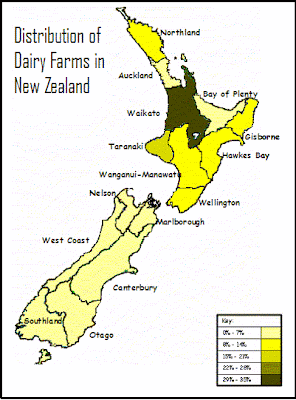
Different farm types have different resource requirements. Dairy farming needs specific natural resources like
- flat land
- fertile soil
- plenty of sunshine and rain
- close to population centres
Look closely at this map to see dairy farming is mostly located. Look at a relief and climate map of New Zealand to see exactly why dairy farming is located in these areas.
2.2 New Zealand’s farming resources
Cultural Resources
PEOPLE:
The people on the farms are resources. They provide labour, knowledge, skills, and perception. All of these affect the type of farming that happens; how the farm is managed, where the farm is bought, and how efficiently the farm is run. An example of farming knowledge is agricultural research (which happens at Ruakura in Hamilton). Farming skills include fencing, shearing and pasturing.
SERVICES:
Another kind of resource is services (these are services to the farmer). These include financial (eg. Rural banks and banking), government (eg. Ministry of Agriculture and Fisheries (MAF) officers and advisors), professional (eg universities), and agricultural (eg. Marketing boards). These provide advice and direction, money, efficiency, informal management and marketing.
FACILITIES:
Facilities include buildings (sheds), technology, machinery and transport for storage and general equipment. New technologies can enable farmers to do certain tasks much faster, allowing them to spend time doing other things.
Natural Resources
LAND:
The kind of land available, affects the kind of farming that happens on the land. For example, a lot of horticulture and dairy farming is found on lowland plains, while gentle rolling hills are used for sheep and beef farming. Most of New Zealand is a mixture of hills and mountains, with plains and plateaus sparsely placed in between. Most farming is carried out on the plains (close to sea level) or on low land plateaus.
SOIL:
Farming needs certain kinds of soils. A deep soil, rich in minerals is best for farming. Soils in New Zealand range from alluvial (to do with rivers) to volcanic and are the result of different natural processes. Many lowland areas have alluvial soils that are good for horticulture. Most of New Zealand is hilly with thin soils which are suitable mainly for tree or grass growth.
SUN:
The sun is responsible for temperature and sunshine hours. New Zealand’s location (between 35˚S and 47˚S) means that overall the country has mild temperatures and high sunshine hours. New Zealand’s temperature (which affects how long and how much you can grow) is excellent for growing in spring and summer and average in winter and autumn. Some temperatures in the north allow you to grow crops all year long. Sunshine hours are important for the ripening of fruit and vegetables (photosynthesis) and growing of grass. Most of New Zealand gets between 1800 and 2200 hours of sunshine per year.
RAIN:
Precipitation (rain, hail, sleet and snow). Plants and animals need water to survive. Much of New Zealand receives at least 1000mm per annum (per year). Fiordland is very wet (well over 3000mm); while Otago can be quite dry (can receive less than 500mm). Water keeps moving between the sky and the earth in the hydrological cycle.